Walk through a suburban neighborhood on a weekday afternoon. The streets are empty. Not quiet — cars pass constantly. But there are no children. No bikes drifting across the road. No shouting from two houses down.
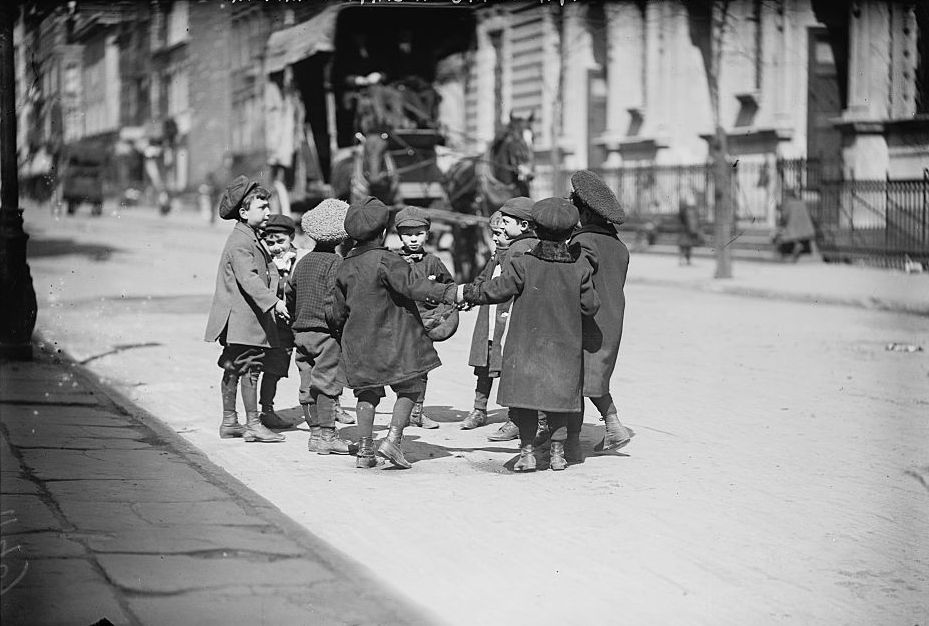
Photographs from the same streets in 1965 show children everywhere.
This is not about screens. Screens filled a vacuum. The question is what created the vacuum.
The Network Effect Nobody Talks About
Play is threshold-dependent. Below a critical mass of children occupying a street, the space stays empty. Above it, the activity becomes self-sustaining. One child out front signals to another that it's worth going out. That child signals to a third. The street activates.
William Whyte documented the same dynamic in adult public spaces fifty years ago. After five years of filming New York plazas with time-lapse cameras, he arrived at a single organizing principle: people go where people already are. An empty plaza stays empty not because it's uninviting but because the absence of people is itself information — a signal that the space isn't working. The same mechanism governs residential streets.
Below the threshold, each child who opens the front door and sees an empty street closes it again. The street stays empty. This is rational behavior in response to an information signal, not apathy.
Three Decisions
Three design decisions, made largely between 1950 and 1990, raised the threshold for outdoor play until it became unreachable on most American residential streets.
The first was traffic volume and speed. Postwar suburban streets were engineered for vehicle throughput. The design standards encoded into road engineering assume that residential streets accommodate vehicles moving at speeds where a collision with a child is often fatal. Parents absorbed this risk without formal analysis. The street stopped being a surface where children could exist without supervision. No policy was announced. The road geometry changed and parental behavior followed.
The second was privatization. Traditional urban housing — tenements, rowhouses, courtyard buildings — concentrated shared semi-public space at ground level. Front stoops, interior courtyards, shared alleys gave children surfaces to play on that were visible from dwellings but outside them. Adults could monitor without actively supervising. Postwar suburban design moved outdoor space to the back. The private backyard solved the problem of private outdoor space by making children invisible to their neighbors. A neighborhood of children in separate backyards has no street life.
The third was liability management of public play. Playground equipment was progressively simplified through legal exposure calculations. The tall slide, the spinning platform, the overhead ladder — each removed because the injury vector was legible to a court. What remained after several decades of this process was equipment designed to prevent injury so completely that children find it boring. Boring playgrounds empty out.
Each decision seemed reasonable in its own terms. Each one quietly raised the minimum viable density of outdoor child activity. Collectively they pushed that minimum past what most neighborhoods could sustain.
The Mental Health Signal
In 2023, 2 in 5 US high school students reported persistent feelings of sadness or hopelessness — up from 1 in 3 a decade earlier, according to CDC Youth Risk Behavior Survey data. That is not a fluctuation. That is a structural change in how a generation of young people are experiencing their daily lives.
Longer data series point in the same direction. Researchers studying MMPI data collected from young Americans between 1938 and 2007 found that five to eight times as many young people now score above the clinical threshold for anxiety or depression compared to the baseline established in the late 1930s. The shift was documented by psychologist Jean Twenge and analyzed in depth by Peter Gray at Boston College, who drew a specific connection to the simultaneous decline in free play.
A 2001 analysis of US time-use data found a 25% decline in unstructured playtime for children aged 6-8 between 1981 and 1997 alone. That covers one generation. The arc before and after runs longer.
The timing is not coincidental. A child who spends their afternoons in organized, adult-planned activities learns, at a developmental level, that the world requires adult authorization before anything interesting happens. A child who builds something in a vacant lot, negotiates the rules of a game with two other children, finds a route home they haven't taken before — that child is practicing a different relationship to agency.
The screen provided a domain where agency came back: low-stakes, immediate, socially connected in a thin way, but yours. It didn't create the appetite. The designed environment created the vacancy; technology moved in.
The Same Problem in Ecosystems
Wildlife conservation faced an equivalent challenge at habitat scale. Isolated forest fragments don't support the same species richness as continuous habitat of the same total area. The minimum viable population for many species exceeds what a single patch can sustain. Populations in isolated fragments collapse not because the patch is too small for individuals but because it's too small for the social dynamics those individuals depend on.
The design solution wasn't to enlarge every patch. It was to connect them. Wildlife corridors — narrow strips of habitat linking larger fragments — allow populations to function as one system despite living in many pieces. Connectivity does work that raw area cannot.
Street design for children needs the same logic. One activated front yard doesn't produce play culture. A street where three or four households have visible front spaces, where vehicles move slowly enough that children can exist in the road, where adults in different houses can see each other's children incidentally — that can cross the threshold. Once past it, the network effect runs in the right direction.
What Works
Dutch municipalities arrived at a design solution in the 1970s called the woonerf — translated roughly as "living street." A woonerf removes the distinction between traffic lane and pedestrian space. No raised curb separates cars from people. Planters, benches, and surface treatments force vehicles to navigate around social activity rather than through it. A car traveling at walking pace is the logical outcome of the geometry; any other speed is physically awkward.
Evidence from Dutch traffic studies showed child pedestrian fatalities falling dramatically on converted streets. The redesign preceded any cultural change in behavior. Alter the conditions; behavior follows.
Research on street calming more broadly shows that streets designed around lower speeds are associated with higher rates of children's outdoor activity — though the relationship is not mechanical. Speed limits alone are insufficient. What matters is the whole environment: whether the street feels safe, whether other children are visible, whether the design signals that slow movement is expected rather than imposed.
What Mike Lanza documented over a decade in his Menlo Park neighborhood follows the same principle at the scale of a single block. He moved the picnic table from the backyard to the front. He installed smooth concrete for chalk and scooters. He put the trampoline in front where it was visible from the street. He organized a neighborhood summer camp. In one summer, 61 of 65 eligible children participated. The intervention wasn't advice to parents. It was environmental design applied at the smallest possible scale.
The Problem Is Still There
Redesigning residential streets for pedestrian priority remains politically difficult in most American contexts. Standard road engineering guidelines encode minimum lane widths and turning radii that make woonerf-style streets technically non-compliant. HOA restrictions prevent the kind of front-yard activation that changes what a street signals. Zoning that separates residential from commercial eliminated the corner stores and small parks within walking distance that gave children destinations to walk toward.
None of this is permanent. Dutch engineers made different choices than American ones. American engineers can make them too.
But the prerequisite is identifying the problem correctly. Children's declining outdoor activity is a consequence of design decisions made over five decades — in road standards, in subdivision codes, in liability law, in zoning ordinances. Those decisions had reasons. They also had costs that were never entered into any ledger.
Screens arrived into a vacancy. The vacancy was designed. That distinction matters because it points to a different category of solution: not parental willpower or screen-time limits, but street geometry, traffic speed, and the placement of a picnic table.