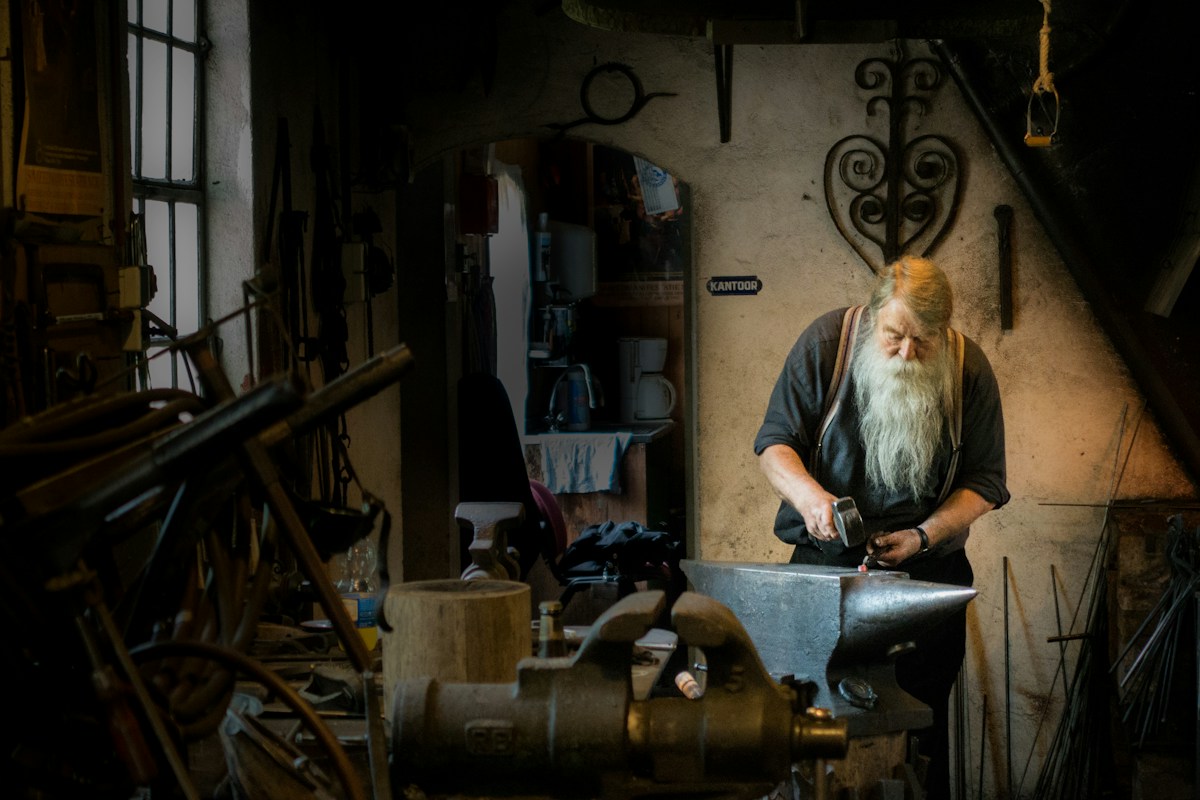
To become a master in a medieval guild, you had to produce a masterpiece. Not a masterpiece in the modern sense — a peak achievement, a career highlight. A masterpiece in the technical sense: a physical object submitted to the guild for inspection, demonstrating complete command of the trade. The goldsmith's masterpiece was evaluated for its joints, its proportions, its surface. The mason's masterpiece was examined for its geometry, its structural logic, its material quality.
The masterpiece was a knowledge audit.
It asked one question: did the transmission work? Did seven years of working beside a master transfer something real, or just the motions of it?
The guild system is usually described as an economic institution. A trade cartel. A rent-seeking arrangement that restricted entry and protected incumbents. This is partially true. But the economic description misses what guilds were actually doing at the level of knowledge.
Craft knowledge is irreducibly multi-modal. It lives in hands, eyes, and ears. A glassblower knows when the gather of molten glass has reached temperature not by reading a thermometer but by its color, its behavior when gravity pulls at it, the tactile feedback through the blowpipe. A stonemason reading stone knows grain direction and failure planes by tapping, pressing, watching how a tool bites. This knowledge is demonstrated and imitated, not described and read.
The philosopher Michael Polanyi gave this a name. His formulation was simple and devastating: we can know more than we can tell. A driver's knowledge of how to handle a vehicle at speed in rain is not degraded theory. It is categorically different from theory. A person who recognizes thousands of faces cannot specify what features distinguish them. Face recognition operates below the threshold of articulation. That is not a deficiency of the recognizer. It is the nature of the knowledge.
Seven years of apprenticeship was the minimum period to build that subsidiary layer. The apprentice living in the master's household was not just learning rules. They were building the embodied competence that allowed them to feel when something was wrong before they could say why.
The guild enforced quality on both sides. Masters had to teach genuinely or face reputation damage. Apprentices had to pass real competency tests. The masterpiece requirement closed the loop: the knowledge had to be demonstrable in a made object, not just verbally attested.
What the Enlightenment Got Wrong
In 1751, Denis Diderot began publishing the Encyclopédie. The project sent illustrators to observe craftsmen directly, sketch their tools and movements, and reduce their practice to reproducible documentation. Seventeen volumes of text. Eleven volumes of plates. The largest systematic attempt in history to extract artisan knowledge into written form.
The goal was democratization. The underlying assumption was that craft knowledge could be so extracted.
Forty years later, the French Revolution tested that assumption. The Le Chapelier Law, passed June 14, 1791, banned guilds outright. The Revolutionaries regarded guilds as collective interest groups incompatible with individual liberty. The law also banned the journeyman fraternal associations and the right to strike. Guilds in France were gone overnight.
The assumption was that the Encyclopédie had already captured what mattered. If the knowledge was in the text, the institution transmitting it was redundant.
The assumption was wrong.
The Losses
Roman concrete has survived 2,000 years in seawater conditions that destroy modern Portland cement in decades. The formula combined volcanic ash (pozzolana), lime, seawater, and aggregate.
The knowledge of this formula was not abruptly lost. It degraded as the empire's building economy contracted and the practices built around it ceased to be regularly executed. Medieval builders reverted to lime mortar, which was weaker but locally available. They had the recipe. They did not have the practiced understanding of why each step mattered.
In January 2023, an MIT-led research team published the mechanism. The key was lime clasts: small white mineral chunks in the concrete that previous researchers had assumed indicated poor mixing. They were actually the active ingredient in a self-healing process. When water seeps into a crack, the lime clasts react to produce calcium carbonate crystals that reseal it. The hot-mixing process that created these clasts was not an accident or a deficiency. It was the crucial innovation. The recipe without the understanding of why it mattered looked like a mistake.
That knowledge was lost for approximately 1,500 years. Not because no one wrote it down. Because the knowledge of why it mattered was never fully articulated.
The same gap appears in Gothic architecture. When the 19th-century Gothic Revival reproduced the visual forms of medieval cathedrals, it worked from drawings. The masons who built Salisbury or Wells had not worked from drawings in the modern sense. They had executed structural logic they had internalized through years of practice: how limestone from specific quarries behaved under load, where a block would fail, how a particular vault form distributed forces. Victorian architects copied the appearance. Many Gothic Revival buildings have ongoing structural problems because the appearance was separated from the structural logic that generated it.
The Notre-Dame de Paris restoration, after the 2019 fire, became an inadvertent demonstration of how narrowly this knowledge had survived. The restoration required traditional timber framers using axes to shape oak beams, stone carvers trained in medieval techniques, stained glass artists. Some 2,000 tradespeople across roughly 250 companies and workshops were involved. Craftsmen came from Guédelon, a castle being built using only medieval tools and methods, partly as a skills-preservation project. The Ateliers Perrault, a 250-year-old carpentry firm, was one of only two companies in France capable of the timber work.
The skills existed. Barely. In a handful of firms and craft schools. Had the fire occurred 50 years later, they might not have.
The Same Loss, Repeated
Guilds were not the only institutions to make this mistake. Every domain that replaced apprenticeship with credentialing made the same error.
The Green Revolution increased wheat and rice yields dramatically from the 1940s onward. It also replaced the Maya milpa system, in which maize, beans, and squash were intercropped in combinations refined over millennia. Maize provided structure for beans; beans fixed nitrogen; squash suppressed weeds. The system required sophisticated knowledge of plant interactions, timing, and local variety behavior. It could not be standardized. Within a generation of farmers switching to certified commercial seed and monoculture practice, the knowledge of how to run a milpa was gone. So were thousands of locally adapted seed varieties.
Medicine divided itself into specialists. The specialist's knowledge is deeper and more precise than a generalist's within their domain. But the generalist's tacit knowledge was different in kind, not just in depth. A GP who has known a patient for years can detect that "this is different from his usual" in a way that no specialist reading a chart can replicate. A 1991 study in the BMJ found that continuity of care directly improved care quality. Longitudinal patient knowledge was substituting for diagnostic investigation. The specialist system cannot replicate this: the specialist sees the patient as a particular problem, not a person over time.
Software development is young enough that its apprenticeship collapse is still happening. The original transmission model was osmosis: junior developers in physical proximity to seniors, learning by overhearing debugging sessions, watching code review in real time, asking quick questions at a desk. Remote work ended this. Economic pressure on mentorship penalized it. LLMs and Stack Overflow replaced the decontextualized answer for the immediate problem, without building the web of understanding that mentorship builds. By 2024, many tech companies had stopped hiring junior developers at all. The pipeline that fed tacit architectural knowledge from experienced engineers to novices had collapsed.
What Some Places Got Right
Germany and Switzerland never fully abandoned the transmission model. Their dual system combines workplace apprenticeship with vocational school attendance. In Switzerland, about two-thirds of young people pursue vocational training after compulsory schooling. Roughly 90% of those VET students train in dual programmes that combine school with real workplace apprenticeship. Youth unemployment in both countries runs substantially below comparable nations without the dual system.
The system is not identical to the guild structure. But it preserves the core: learning is primarily done in the presence of someone who already knows how to do it.
Japan was more explicit about what was at stake. Its Living National Treasure program, established under the 1950 Law for the Protection of Cultural Properties, designates individual craftspeople as living repositories of irreplaceable knowledge. The first cohort was named in 1955. Each designated master receives an annual government stipend of 2 million yen. Not as payment for products. As funding for a transmission relationship. The government is paying for someone to stand next to a master for years.
The program's design reflects a sophisticated understanding of the problem. Knowledge does not live in institutions or documents. It lives in people. To protect it, you protect the person, and the relationship that allows transmission.
The Credential Is a Map
Every society eventually has to choose between two things: efficiency in the short run, or transmission in the long run.
The credential system is extraordinarily efficient at the short problem. It codifies minimum competence into examinations. It scales. It is legible and comparable. A credential from one institution is readable by an employer in another country. The system produces practitioners quickly.
It handles explicit knowledge well and tacit knowledge poorly. The licensed architect has passed examinations in structural principles and code compliance. The medieval master mason had all of that — plus seven or more years of material experience, the embodied knowledge of what stone does under load, and the judgment that comes from having watched structures fail. One is a map. The other includes the territory.
The guild system, for all its economic pathologies, was an institution designed around the answer to that question. The journeyman's wanderjahr, the masterpiece requirement, the seven years of living in the master's household: these were not bureaucratic excess. They were the minimum architecture required to transmit what cannot be told.
We dissolved that architecture and kept the credential. We kept the map and called it the territory.
Roman concrete repaired itself for 2,000 years through a mechanism we could not understand for 1,500 of them. It required hot mixing, specific sourcing, a practiced sequence that only made sense if you knew why it mattered. The recipe without the understanding of why it works looked like a mistake.
That is what we keep doing. We take the recipe. We lose the understanding. And then we wonder why the structures do not hold.