# The World's Most Livable Cities Are Not the Ones You Think
Every year, three major indices — the EIU Global Liveability Index, the Mercer Quality of Living Survey, and Monocle's Quality of Life Index — rank cities by how well they serve the humans who live in them.
The same names appear at the top every year. Vienna. Copenhagen. Zurich. Amsterdam. Geneva. Melbourne.
Not New York. Not London. Not Tokyo. Not Singapore. Not any of the cities that dominate global finance, culture, or power.
This is not an accident. It is a signal.

What the Rankings Are Actually Measuring
The EIU scores 173 cities across 30+ indicators: stability, healthcare, culture, education, infrastructure. Mercer assesses 231 cities on 39 factors. Monocle focuses on quality of urban life — transport, safety, green space, design, cultural vitality.
These indices don't agree on everything. But across all three, the same cluster of European and Australasian cities dominates. Copenhagen topped the EIU in 2025. Vienna held the top spot from 2022 to 2024. Zurich is consistently in the top three of all three indices simultaneously.
The question worth asking is not which cities top the list. It is: what do they have in common that the financial and cultural powerhouses don't?
The Building Typology Answer
The most livable cities are not high-rise cities.
Vienna's historic building codes — rooted in 19th century Gründerzeit ordinances — capped building heights at roughly 25 meters. The result: a city of 6-to-8 story perimeter blocks, continuous street frontage, and enclosed courtyards. The Viennese Gemeindebau — social housing blocks built from the 1920s onwards — used the same typology. Courtyards. Street-level activity. Mixed income residents sharing the same building.
Copenhagen is predominantly 4-to-6 stories. Amsterdam's canal ring, a UNESCO World Heritage site, is built on the same logic: narrow plots, continuous facade, buildings that meet the street rather than retreating behind it. Zurich's Altstadt has been protected from large-scale redevelopment for decades.
High-rise buildings, by contrast, use approximately twice the energy per square meter compared to mid-rise equivalents, and carry 40% higher embodied carbon. They are more expensive to maintain, harder to retrofit, and produce none of the street-level conditions that generate urban vitality.
The most livable cities built at human scale and held that line. The aspiring global cities built vertically to maximize land value and are now trying to retrofit what they destroyed.
The Paradox of Power and Livability
Vienna has 1.9 million people. Copenhagen has 700,000. These are not global metropolises by economic measure.
New York has 8 million. London has 9 million. Tokyo has 14 million in the city proper. These cities generate vastly more GDP, host the world's major financial institutions, and attract the most globally mobile talent.
And yet a nurse in Vienna, by multiple measures, lives better than a banker in Manhattan.
The mechanism is straightforward. Cities optimized for capital flows generate enormous wealth and enormous inequality simultaneously. Infrastructure strains under population pressure. Housing costs price out the middle class. Public space is crowded and underinvested. The city serves transactions, not inhabitants.
Cities optimized for residents — medium-sized, welfare-state frameworks, strong social housing, genuine investment in cycling and transit — do the opposite. Vienna allocates 120 square meters of green space per resident. 60% of Viennese residents live in subsidized housing, including middle-income households. The city is not cheap. But it is not extractive.

Copenhagen's Streets Are a Policy Decision
49% of Copenhagen residents commute by bicycle daily. 1.44 million kilometers are cycled in the city every day. Between 2010 and 2014, the city invested approximately €80 million in cycling infrastructure.
This is not a cultural quirk. It is an infrastructure decision replicated in Amsterdam, Utrecht, and Groningen. Build protected cycling lanes, design streets where cycling is the obvious choice, and people will cycle. Build highways and surface lots, and they will drive.
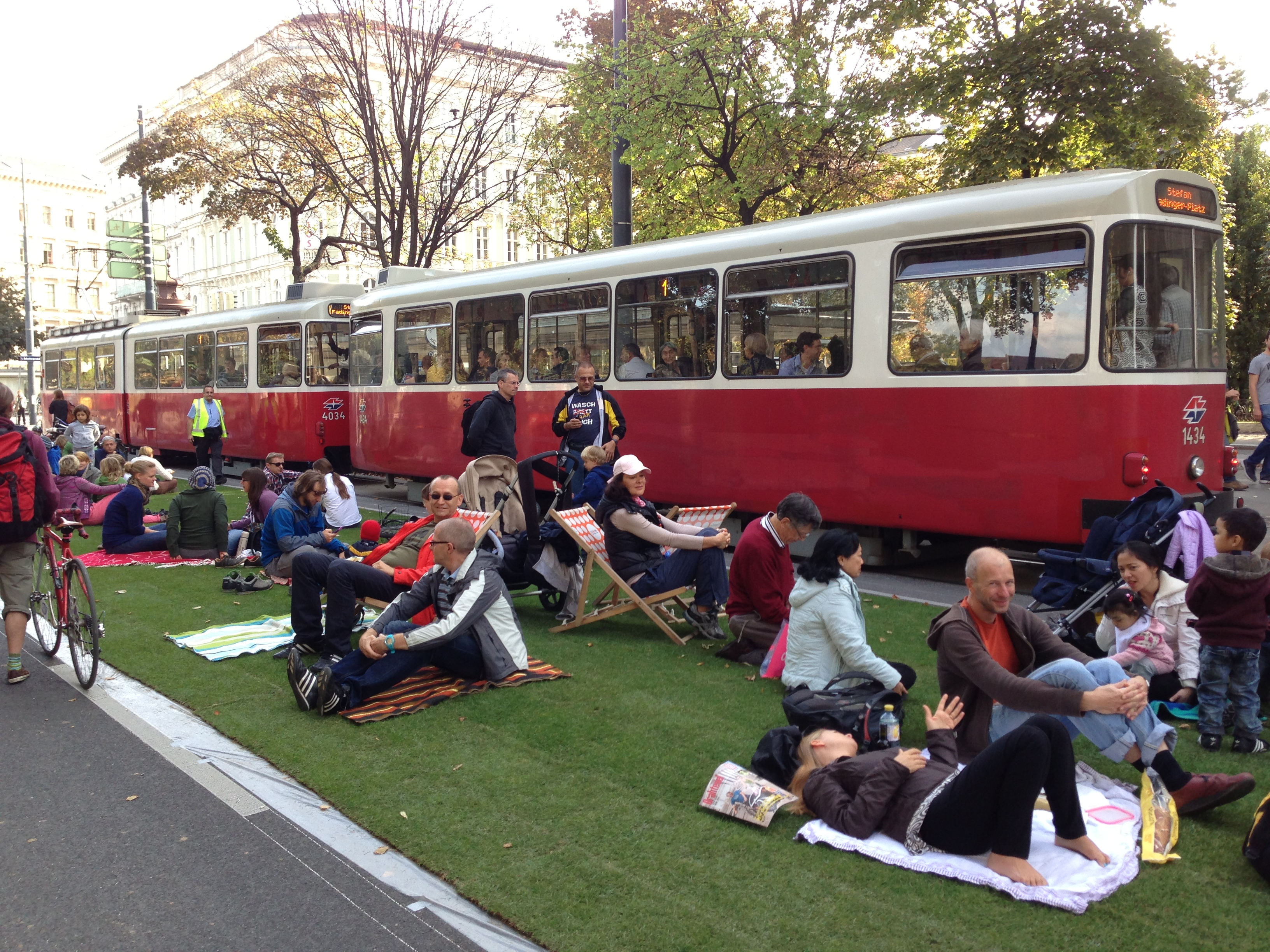
The street is the most important public space in any city. Copenhagen's streets are designed for the people who use them. Most cities design streets for the vehicles that pass through them.

What Christopher Alexander Would Say
Alexander spent fifty years documenting what makes built environments feel alive. His 15 properties of living structure — levels of scale, positive space, gradients, roughness, not-separateness — read like a description of Vienna's street grid.
The Viennese perimeter block has levels of scale: building facade, window rhythm, cornice detail, street tree canopy, the enclosed courtyard inside. Positive space: the courtyard is not leftover land, it is a designed center. Gradients: the transition from public street to semi-public entrance to private apartment is graduated, not binary.
The modernist slab block has none of these properties. One scale. Leftover space between towers. No gradient from public to private. No center. Dead on every metric Alexander identified.
The livability rankings are measuring, in their own way, the same thing Alexander measured: how alive a built environment feels to the humans within it.
What This Means for Every City Building Right Now
The cities topping livability rankings are not exceptional. They are normal — they simply refused to abandon what worked.
Human-scale street grids. Mixed income in the same buildings. Enclosed courtyards that give every resident access to green space and daylight. Cycling infrastructure that makes cars optional. Social housing that keeps teachers, nurses, and tradespeople living in the city rather than being pushed to its edges.
None of this is new technology. None of it requires innovation. It requires institutional will to hold the line against development pressure, land speculation, and the ideology that taller is better.
Vienna and Copenhagen are not livable because they are rich. They are livable because they decided that the purpose of a city is to serve the people who live in it.
Every city that builds glass towers instead of courtyard blocks, that removes cycling infrastructure for parking, that sells off social housing to fund short-term budgets — is making a different decision. One whose consequences will take decades to become fully visible.
The evidence from every index is consistent. The decision has been made. Most cities are simply choosing to ignore it.