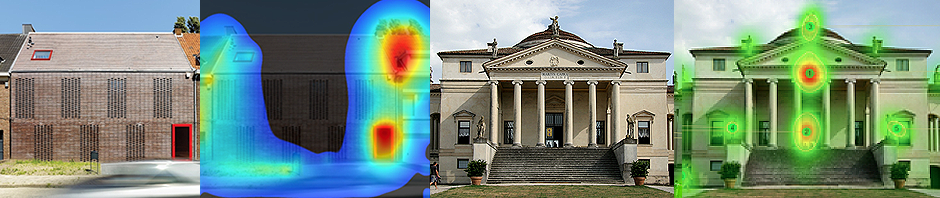
Two federal buildings. Same city. Same function. Completely different outcomes in an eye-tracking study.
The Clinton Federal Building in Atlanta — classical, with columns, arching windows, and ornamental detail — generates a heat map that glows red across its entire facade. Warm patches everywhere. The eye moves, anchors, explores, finds something at every level.
The Robert C. Weaver Federal Building in Washington, the modernist headquarters of HUD — bare concrete, horizontal banding, no ornament — barely generates a single red dot. Researchers described it as a building people "barely focused on at all."
This is not a matter of taste. It is a measurable difference in how the human visual system processes what it sees. And it fires before your opinion forms.
The Pre-Conscious Test
Ann Sussman, an architect and biometric researcher, has spent years applying eye-tracking technology to the question nobody in the mainstream architectural world wanted to ask: what are buildings actually doing to the people in front of them?
The methodology she and her colleagues use is rigorous. 3M's Visual Attention Software aggregates data from decades of eye-tracking studies to predict, with measurable accuracy, where the human gaze will land within the first few seconds of encountering an image — before conscious viewing comes online. Before gender, age, or cultural background affect perception.
The results are consistent across hundreds of building pairs. Traditional facades maintain heat map coherence at every zoom level. As you move closer in — from the whole building to a section to a detail — the eye keeps finding new things to anchor on. Columns at one scale, capitals at the next, molding at the next.
Modern facades fall apart on zooming. There is nothing at the intermediate scales. The eye has nowhere to go. The heat map scatters and fades.
A 2020 paper by Salingaros and Sussman in Urban Science confirmed the mechanism: the software predicted this outcome before any human subjects were tested. The response is not aesthetic opinion. It is closer to optics.
The Survey That Silenced the "It's Just Preference" Argument
In August 2020, the National Civic Art Society commissioned a Harris Poll of 2,039 Americans on their preferences for federal building architecture.
Seventy-two percent preferred traditional civic architecture over modernist alternatives. Democrats: 70%. Republicans: 73%. Independents: 73%. Women: 77%. Men: 67%.
The most preferred building was the National Archives: 83% approval. The least preferred was the Robert C. Weaver Federal Building — the same one that barely generated a red dot in the eye-tracking study: 19%.
When a preference is this consistent across party lines, gender, and geography, it stops being a preference and starts being a signal about something biological. You cannot construct a political or cultural explanation for unanimous cross-demographic agreement.
Why Fractal Complexity Reduces Stress by 60 Percent
Richard Taylor, a physicist at the University of Oregon, has spent decades studying the mathematics of fractal patterns in art and architecture. His finding: fractal geometries within a specific complexity range — a fractal dimension of 1.3 to 1.5 — reduce physiological stress by up to 60 percent, measured through skin conductance and EEG.
The mechanism is what Taylor calls "fractal fluency." The human visual system evolved in natural environments — forests, coastlines, mountains, rivers — all of which exhibit fractal complexity at multiple scales. The brain has developed efficient neural pathways for processing mid-range fractal patterns. When it encounters them, stress responses dampen and a relaxed attentiveness follows.
Traditional architecture, across virtually every culture, falls within that fractal range. Gothic tracery, Islamic geometric ornament, Indian temple carvings, Japanese wooden lattice — all operate at roughly 6 to 10 hierarchical levels of visible detail, precisely where human visual processing is most at ease.
Modernist surfaces run near a fractal dimension of 1.0: no hierarchical complexity, no variation, no sub-scale detail. Blank concrete and glass curtain walls give the visual system nothing to process. Not minimalism. Deprivation.
The Savanna Your Brain Is Still Looking For
In 2010, researchers Falk and Balling published a study in Environment and Behavior that has become one of the strongest pieces of evidence for innate environmental preferences. They showed landscape photographs to participants from multiple cultures, including Nigerian rainforest communities with zero personal exposure to savannas.
The savanna — open grassland with scattered trees, water features, and long sight lines — was chosen as the most desirable landscape by nearly every group, including the rainforest communities who had never seen one.
This matters for architecture because it illuminates what "beautiful" is tracking at a deep level. The preferences are not learned. They are not cultural. They appear to be a memory the species carries for the environments where cognition evolved.
Appleton's prospect-refuge theory extends this to built space: humans seek environments that combine prospect (long views, ability to see threats) and refuge (sheltered enclosure, overhead cover). Traditional architecture delivers this systematically: deep porches, bay windows, arcaded streets, interior courtyards open to the sky. These spatial sequences are not arbitrary aesthetic choices. They are the resolution of an evolutionary calculus.
The modernist open plan — exposed, centerless, no enclosure — violates both. The glass curtain wall eliminates refuge entirely and reduces prospect to a single undifferentiated transparency.
What the Eye-Tracking Studies Are Actually Telling Us
Sussman's research connects back to Christopher Alexander's observation that traditional buildings operate at multiple levels of scale simultaneously — and that modern buildings, almost without exception, do not.
Alexander spent 30 years building a scientific vocabulary for why some buildings feel alive. The eye-tracking data provides the biological mechanism: the gaze system is literally searching for sub-scale detail and finding nothing. Not indifference. Active search with no result. That search, repeated across thousands of glances, is experienced as the building's emptiness.
The pre-conscious response does not wait for your architectural education to catch up. It fires in the first seconds of encounter. You can train yourself to appreciate modernist architecture intellectually. You cannot train the pre-conscious visual system out of its evolutionary preferences. They are older than any theory.
The Implication
A 2020 Harris Poll found 72% of Americans prefer traditional federal architecture. Eye-tracking studies confirm traditional buildings hold gaze and generate rich attention; modern ones barely register. Taylor's physics shows fractal ornament reduces physiological stress by 60%. The evidence runs across neuroscience, perceptual psychology, and evolutionary biology.
The architecture profession's response, for most of the last century, was to treat this convergence as irrelevant. The buildings people actually want to be in, the buildings that generate warm heat maps and physiological ease, were coded as backward, bourgeois, sentimental.
The buildings that the eye slides off — that barely generate a single red dot — were coded as sophisticated.
The evidence has accumulated long enough. The sophistication was in the wrong direction.